
Reviewed · ANURADHAPURA TOURS
Anuradhapura Heritage Mountain bike / bicycle Tour
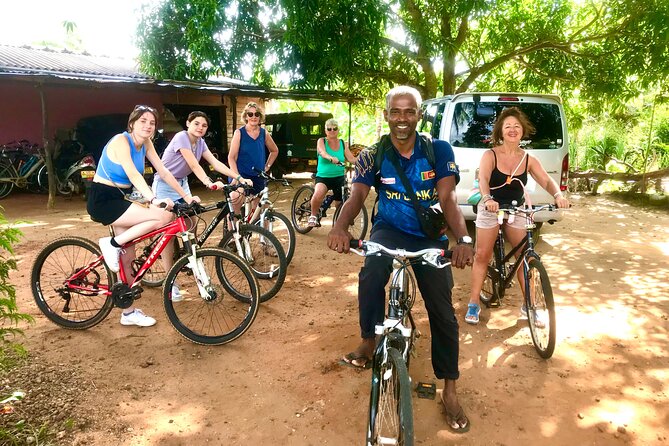
Anuradhapura is much easier to understand from a bicycle than from a car. On this 10 km private loop, guide Saranga takes you between huge stupas, old reservoirs, temple ruins, forest tracks, and quieter local areas that are easy to miss on a standard sightseeing drive. You get history, exercise, and a close look at daily life in one half-day outing.
I like the slow pace, which gives you time to look closely at carved stones and ancient waterworks. I also like the personal touch: Saranga explains Buddhism and local customs, then takes you to places near rice fields and quiet roads. The main catch is the extra $30 UNESCO entrance ticket, which is not included in the $25 tour price. You also need moderate fitness and suitable clothing for temple visits.
Key points at a glance
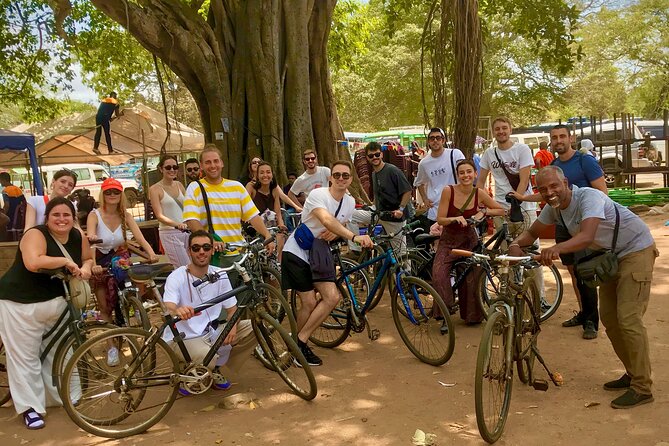
- A 10 km heritage loop: Four and a half hours gives you time to visit Anuradhapura’s main sacred and archaeological sites without rushing from one photo stop to the next.
- A personal English-speaking guide: Saranga leads this private outing and adds context about Buddhism, local culture, and the ancient city.
- Quality mountain bikes: The tour provides mountain bicycles from brands such as Giant, Trek, and Louis Garneau.
- Major sites and quiet routes: You visit Jetavanaramaya, Abhayagiriya, Ruwanweliseya, Sri Maha Bodhi, ancient pools, and irrigation tanks.
- Food and water included: Bottled water and a vegetarian meal prepared by local people at Hela Bojun are part of the experience.
- Budget for the heritage ticket: The $25 tour price does not include the $30 UNESCO ticket, or the $15 ticket for children under 13.
Why a bicycle makes sense in Anuradhapura
Anuradhapura covers a wide area, and its important places are scattered among trees, tanks, monasteries, and open ground. A vehicle gets you from one point to another, but a bicycle lets you notice the spaces between them.
You can pedal along quieter stretches, stop without hunting for a parking place, and take in the changes from town to forest to rice fields. The route is described as a loop of about 10 kilometres, but the four-and-a-half-hour timing shows that this is not a race. Much of the value comes from stopping, listening, and asking questions.
This is a private tour, so your group is not combined with strangers. That matters at religious sites. You can spend longer at a statue or ask Saranga to explain a Buddhist symbol instead of following a fixed group schedule.
The ride is not presented as a hard cycling challenge, but you should be comfortable with a moderate level of physical activity. The day includes repeated cycling, walking around ruins, and standing at temples. The supplied mountain bikes are intended for this type of outing, with bicycles from established brands including Giant, Trek, and Louis Garneau.
More ancient city days:
- Private City Day Tour in Anuradhapura
★ 5.0 · 383 reviews - Explore & Ride the history of anuradhapura with Vogel Tours
★ 5.0 · 62 reviews - Delve Into Ancient Anuradhapura with Optional Visit to Mihintale
★ 5.0 · 42 reviews
Starting near the old car park
The meeting point is Rides Hubwela Mada Gedara, Garage Waththa, near the old car park at 116/1 Watawandana Road in Anuradhapura. The tour finishes at the same place, which keeps the arrangement simple.
Parking fees are included, and the location is near public transportation. Confirmation is provided when you book, so you should have the meeting details available on your phone. The mobile ticket is useful here, especially if you are arranging several activities during a Sri Lankan trip.
Before setting off, check that your clothing is suitable for Buddhist temples. If your knees are uncovered, bring a wraparound cloth. This is not a minor detail. Sacred places in Anuradhapura require respectful dress, and having a cover with you saves time and embarrassment.
Jetavanaramaya, the first great stop
The ride begins with Jetavanaramaya, one of Anuradhapura’s most striking stupas. When King Mahasena built it between 273 and 301, it reached about 122 metres, or 400 feet. At that time, it was regarded as the tallest stupa in the world and one of the tallest structures anywhere.
You have about 15 minutes here. That is enough for an introduction and photographs, though it is not a long archaeological visit. The scale is the point. From ground level, the brick mass gives you a feel for the ambition and engineering behind the ancient capital.
This first stop also sets the tone for the day. Anuradhapura is not one isolated monument. It is a large religious and civic centre spread through a wide area, and cycling helps you grasp that size.
Samadhi Statue and the meaning of a quiet stop
The Samadhi Buddha is a famous seated image in Mahamevnawa Park. The Buddha is shown in the meditation posture known as Dhyana Mudra, a pose linked with his first meditation.
You have about 20 minutes here. That gives you more breathing room than the short Jetavanaramaya stop. This is a good place to slow down and consider how the site functions as a place of devotion, not simply as an archaeological object.
Saranga’s experience with Buddhist culture is one of the strongest reasons to choose a guided ride instead of going alone. The tour’s past customers particularly valued his explanations of Buddhism and his personal insight. You can ask questions in the moment, which is often more useful than reading a paragraph on a sign.
More Bike Tours in Anuradhapura:
- Half-Day Lagoon and Village Cycling Tour in Galle
★ 5.0 · 90 reviews - Galle Fort and City Cycling Tour – Choice of E-Bike or Manual
★ 5.0 · 28 reviews
Abhayagiriya and the ancient monastery complex
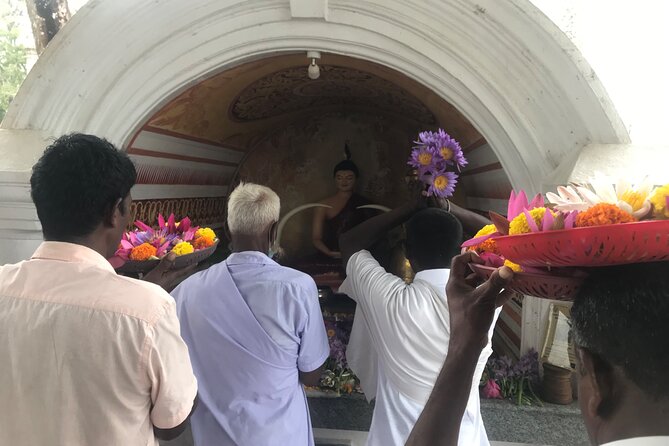
Abhayagiriya Stupa forms part of one of the world’s largest archaeological monastic areas. Abhayagiri Vihara was associated with Mahayana, Theravada, and Vajrayana Buddhism, making it an important place for understanding the range of Buddhist traditions present in ancient Sri Lanka.
The stop lasts about 20 minutes, but the surrounding area deserves attention as you move through it by bicycle. You are not only looking at one monument. You are passing through the remains of a large religious institution with pools, buildings, courtyards, and service areas.
The scale can be hard to grasp when you see the ruins one at a time. A guide helps connect them. Saranga can explain how the monastery worked and why the smaller structures around the main stupa mattered.
Twin Baths and the Elephant Pond
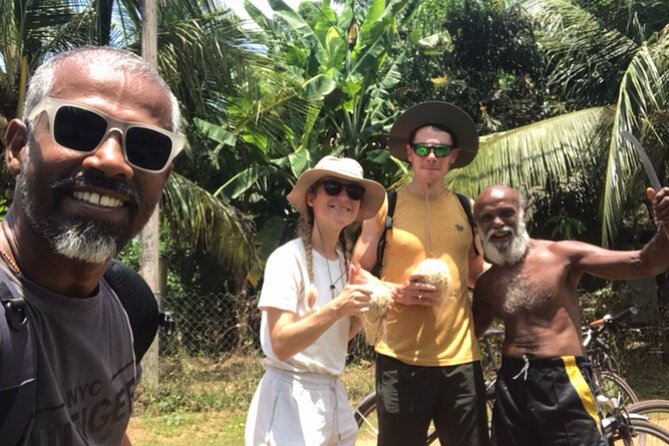
Kuttam Pokuna, known as the Twin Baths, consists of two carefully built bathing pools from the ancient Anuradhapura Kingdom. The stone steps, edges, and water channels show a high level of planning.
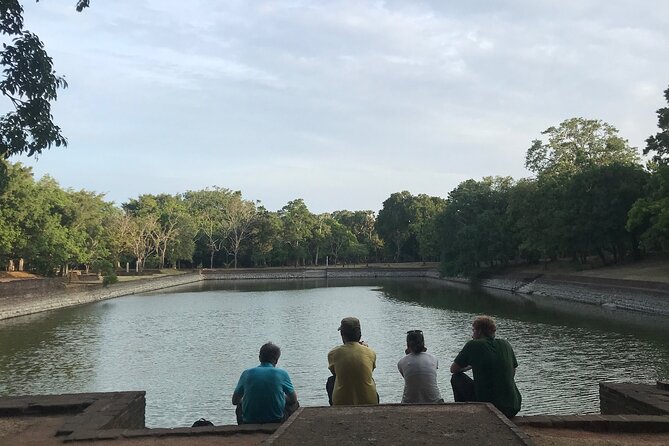
You have roughly 20 minutes here. Look beyond the surface beauty of the pools. They show how water was managed for religious and practical use, and they offer a useful contrast with the giant stupas. Anuradhapura’s achievements were not only spiritual. They also involved engineering, sanitation, and the careful control of water.
The next stop is Eth Pokuna, or Elephant Pond, another enormous ancient reservoir. It measures about 159 metres long and 52 metres wide. The name gives you a sense of its scale, but the dimensions make the point clearer.
Again, the bicycle is useful. You can move through a large historic area without treating every stop as an isolated roadside attraction. The 20-minute visit is long enough to take in the size and hear how these water systems fitted into the wider city.
The Moonstone and the art at your feet
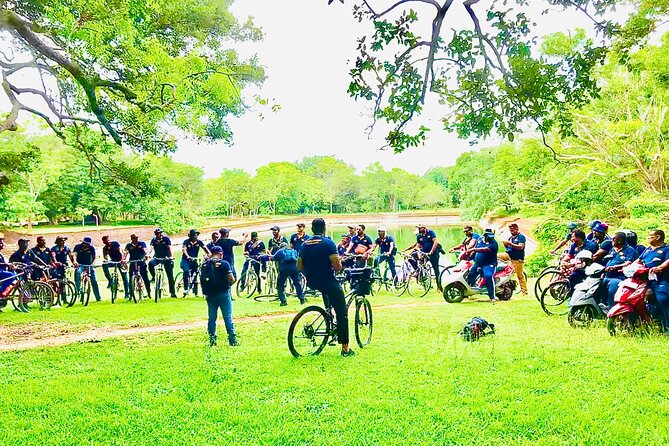
The Sandakada Pahana, or Moonstone, is a carved semicircular stone usually placed at the bottom of a staircase or entrance. Its design is one of the distinctive features of ancient Sri Lankan architecture.
The tour allows about 25 minutes here, giving you time to look closely. This is a stop where the details matter more than the overall size. You will want to pay attention to the carving and the way the stone marks a transition into a sacred space.
If you tend to focus only on stupas, this stop broadens the picture. Anuradhapura’s artistry appears in thresholds, steps, pools, and small architectural details as well as in its monumental structures.
Basawkkulama Tank and ancient water planning
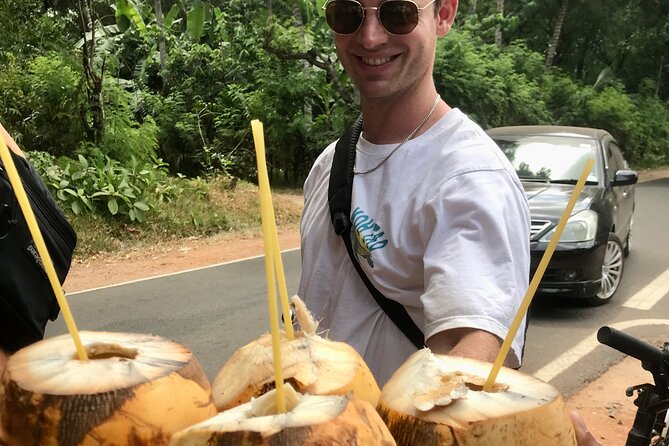
Basawkkulama Tank introduces one of Anuradhapura’s most important subjects: irrigation. Sri Lanka developed complex water systems over many centuries, with early irrigation works dating to about 430 BCE, during the reign of King Pandukabhaya.
The tour gives you about 20 minutes here. This is a chance to connect the large reservoirs with the fields and settlements that depended on them. The tank is not just a scenic pause. It helps explain how an ancient capital could support a large population and extensive religious institutions.
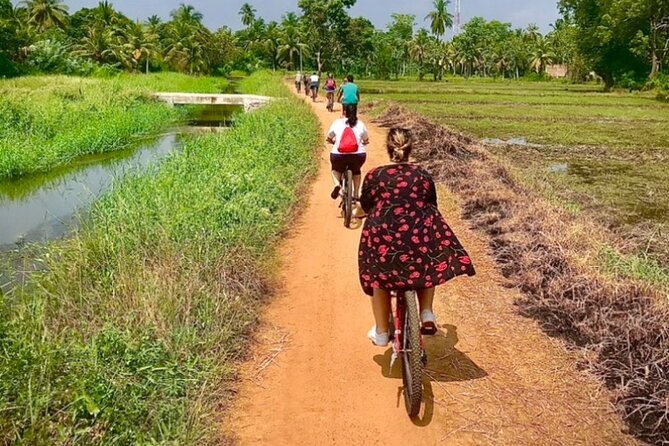
The route around this part of the city is also where the quieter character of the ride becomes especially valuable. The experience includes forest routes and rice-field scenery, and the peaceful stretches provide a break from the monument-by-monument rhythm of the heritage area.
The Abhayagiri refectory and the size of monastic life
The main refectory of Abhayagiri Monastery is a short 10-minute stop, but it adds an important practical detail. The Chinese monk Fa-Hien, who visited in the fifth century, recorded that as many as 5,000 monks lived at the monastery.
A refectory gives that number meaning. Religious communities require food, kitchens, storage, labour, and organisation. This was not a small retreat with a single shrine. It was a major institution with the resources to feed a very large community.
The short stop works well in the middle of the circuit. You do not need a long visit to understand the basic function of the building, especially with Saranga explaining how the monastery operated.
Ruwanweliseya, one of Anuradhapura’s grandest stupas
Ruwanweliseya receives about 30 minutes, the longest stop so far. King Dutugamunu built it between 137 and 119 BCE, and it remains one of the city’s most important sacred monuments.
This is a place where you should allow yourself time to watch the religious activity around the stupa. Ceremonies may be taking place, and the atmosphere can change as the day goes on. The tour’s past customers especially valued seeing ceremonies near sunset, although the exact timing and conditions will depend on the day you choose.
The stupa is an active place of worship, so behave as you would at any Buddhist temple. Dress modestly, follow Saranga’s instructions, and remember that this is more than a photo stop.
Sri Maha Bodhi, the spiritual heart of the route
The final major stop is Sri Maha Bodhi, a sacred fig tree in Mahamevnawa Gardens. It is described as the closest authentic living link to Gautama Buddha, which explains its importance to Buddhist worshippers.
You have about 30 minutes here. That length is appropriate because this is a place for quiet observation rather than quick sightseeing. The tree is part of a living religious setting, and you should be prepared for a more devotional atmosphere than at a ruined wall or empty pool.
Ending with Sri Maha Bodhi gives the circuit a strong spiritual finish. You have already seen monasteries, tanks, carved stones, and stupas. Here, the focus shifts from ancient brick and stone to a living symbol that continues to draw worshippers.
What the $25 price really covers
The listed price is $25 per person. For a private four-and-a-half-hour tour with a bicycle, guide, bottled water, parking fees, and a local vegetarian meal, that is a reasonable package.
The important qualification is the separate UNESCO ticket. You must pay $30 per person, or $15 for a child under 13. That means an adult should budget $55 in total before booking, not $25. The ticket cost changes the value calculation, but you are paying for access to a large collection of major sites rather than one single monument.
The included meal is prepared by local people at Hela Bojun and is vegetarian. This makes the tour more than a ride between ruins. It gives you a chance to eat a simple local meal during the outing, though the supplied information does not specify the exact dishes or meal time.
Who will get the most from this ride
I would choose this tour if you want Anuradhapura to feel like a place rather than a checklist. Saranga’s explanations of Buddhism, local culture, and the meaning of the sites are central to the experience.
It suits you particularly well if:
- You enjoy gentle cycling more than sitting in a vehicle all day.
- You want a private tour that can focus on your interests.
- You like ancient engineering, especially tanks and water systems.
- You want major monuments plus quieter routes through forests and rice fields.
- You are comfortable with moderate physical activity.
- You value a local vegetarian meal as part of the day.
It may not suit you if you want a short, effortless sightseeing trip or if you are counting every cost closely. The UNESCO ticket is a substantial extra charge, and the tour requires clothing suitable for temple visits and enough fitness for several hours on a bicycle.
Booking, weather, and practical details
Free cancellation is available if you cancel at least 24 hours before the start time. Cancellations made later are not refunded, and changes made inside that 24-hour window are not accepted.
The tour requires good weather. If poor weather causes cancellation, you will be offered another date or a full refund. Since this is an outdoor ride, check the forecast and keep your schedule flexible when possible.
The experience is private, and only your group participates. Confirmation arrives at booking, and the activity starts and ends at the listed meeting point. Public transportation is nearby, and parking fees are included.
Should you book the Anuradhapura bicycle tour?
Book it if you want a thoughtful half-day introduction to the ancient city, especially if you prefer moving at a human pace. The strongest parts are the private format, Saranga’s Buddhist and cultural explanations, the quiet routes through rice fields and forest, and the chance to connect grand monuments with ancient water management.
Before booking, add the $30 UNESCO ticket to the advertised price and bring a cloth to cover your knees if needed. If you can handle moderate cycling and want more than a fast run through the headline sights, this tour offers a well-balanced way to see Anuradhapura.
FAQ
How long does the Anuradhapura bicycle tour last?
The tour lasts approximately 4 hours and 30 minutes.
How far do you cycle?
The route is described as a 10 kilometre loop through the Anuradhapura heritage area.
Who guides the tour?
Saranga, an English-speaking guide from the Anuradhapura area, leads the tour.
Is this a private tour?
Yes. Only your group participates in the activity.
What kind of bicycle is provided?
A mountain bicycle is provided. The operator uses bikes from brands such as Giant, Trek, and Louis Garneau.
Is the UNESCO entrance ticket included?
No. The UNESCO ticket costs $30 per person. Children under 13 pay $15.
What is included in the tour price?
The price includes the mountain bicycle, guide service, bottled water, parking fees, and a vegetarian meal prepared by local people at Hela Bojun.
Where does the tour start and finish?
It starts at Rides Hubwela Mada Gedara, Garage Waththa, near the old car park at 116/1 Watawandana Road in Anuradhapura. It ends back at the same meeting point.
What should I wear for the temple visits?
Bring a wraparound cloth if your knees are not covered. You will be visiting Buddhist temples and should dress respectfully.
What happens if the weather is poor?
If the tour is cancelled because of poor weather, you will be offered a different date or a full refund. Free cancellation is also available up to 24 hours before the start time.
More History Tours in Anuradhapura
- Visiting the Historical Polonnaruwa Ruins and Minneriya Safari
★ 5.0 · 16 reviews - Day tour to Sigiriya,Dambulla & Polannaruwa (3 word heritage places) from Kandy
★ 5.0 · 99 reviews - Kandy Heritage City Tour by tuktuk
★ 5.0 · 61 reviews - I Day Kandy Heritage Culture Tour
★ 5.0 · 53 reviews
Recently listed around Anuradhapura
- Yala National Park: 7 hours or 12 hours Leopard Wild Safari★ 4.7 · 11 reviews
- Hurulu Eco Park: 3-Hour Morning or Evening Safari★ 4.9 · 11 reviews
- Minneriya National Park : Private Safari★ 4.9 · 11 reviews
- Minneriya National Park 4×4 jeep Safari Include Entrance Fee★ 4.8 · 12 reviews
- Safari Adventure in Minneriya national Park Sri Lanka★ 5.0 · 13 reviews
- Day Tour from dambulla to Sigiriya & Polonnaruwa★ 5.0 · 13 reviews
- Day tour trips from Anuradhapura to multiple cities as your choice★ 5.0 · 14 reviews
- Private Day Trip to Sigiriya , Dambulla and Pidurangala Rock★ 4.5 · 14 reviews
Anuradhapura Tours, compared.
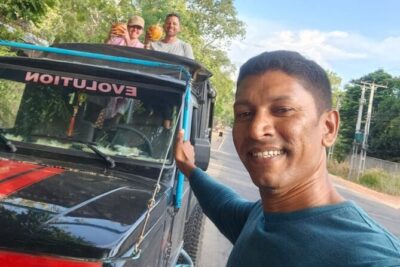
Minneriya National Park Elephant Jeep Safari Private Tour
Read our review →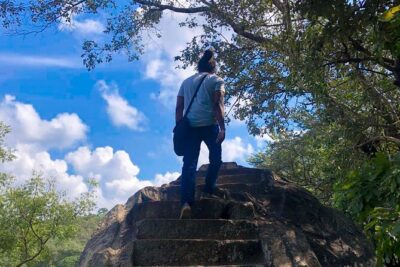
Explore & Ride the history of anuradhapura with Vogel Tours
Read our review →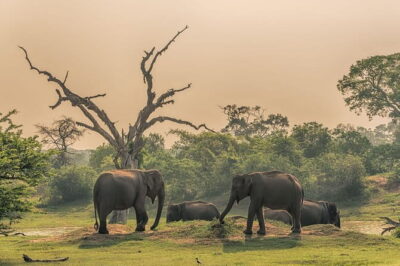
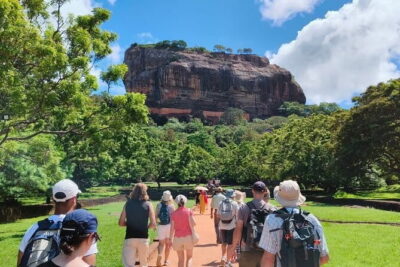
Sigiriya Hike & Minneriya Safari Private Full Day Tour
Read our review →
Sigiriya & Habarana: Sunrise Hot Air Balloon Ride Experience
Read our review →
Minneriya National Park Safari – Private Jeep with Hotel Pickup
Read our review →
Delve Into Ancient Anuradhapura with Optional Visit to Mihintale
Read our review →
Browse the lists this tour appears in